
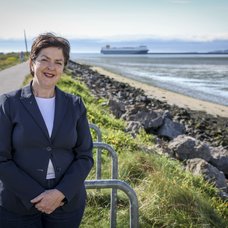
Prof. Fiona Regan
Fiona Regan is Full professor in Chemistry at the School of Chemical Sciences in Dublin City University and is Founder and Director of the DCU Water Institute. Fiona obtained her PhD in Analytical Chemistry in 1994 at DCU after which she took up her first academic position at Limerick Institute of Technology. In 2002 she joined the School of Chemical Sciences in DCU and took on the award of Beaufort PI in Sensors and Communications Technology and coordinator of SmartBay Ireland (2009-2016) – Ireland’s marine test and demonstration platform. Fiona has served as a scientific and technical advisor with the WaterJPI for 6 years and she is the chair of the Scientific and Technical Advisory Board of the Water4All Partnership. Fiona is the current chair of the Royal Irish Academy’s Climate Change and Environmental Science Committee, a role she took up in 2023. Fiona serves as a member of the Scientific Committee of the Food Safety Authority of Ireland, she is an advisor to Aquawatch Australia and is a member of the Royal Society of Chemistry’s Water Science Forum. She was awarded the RSC-WSF Water for Life Award in 2019 and the DCU President's Reserach Award in 2020. Fiona was recipient of the Institute of Chemistry of Ireland Eva Philbin Award in 2026.
Fiona’s research interests include water monitoring using new bio-and chemical sensing technologies, eDNA, marine and freshwater contaminants of concern and climate-related water quality impacts. She has >200 published works including journal articles, abstracts, books and book chapters and has an h-index of 48 (Google Scholar).
Research Interests
Our research group bridges the gap between material science, analytical chemistry, and environmental informatics to solve critical aquatic challenges. We pioneer source-to-sea monitoring innovations, developing state-of-the-art devices and decision support tools that track emerging contaminants across functionally connected freshwater, coastal, and marine ecosystems.
Our core research operates across three interconnected pillars: Innovative Separation & Extraction Systems: We design advanced nanoparticle-based and polymeric materials to enhance the extraction, passive sampling, and enrichment of emerging contaminants (e.g., phthalates, pharmaceuticals, and marine toxins).Next-Generation Sensing Platforms: We develop high-performance microfluidic sensing platforms, visual sensors, and autonomous sensor networks for real-time, high-fidelity environmental and marine monitoring (including nutrient tracking).Deployment Solutions & Collaborative Decision Tools: To ensure long-term field deployment, we engineer novel anti-biofouling nanoparticle coatings. Crucially, we translate our sensor data into actionable insights using advanced decision support frameworks and citizen science tools, empowering communities and stakeholders to participate directly in real-time water quality protection.
If interested in hearing more about our research contact me: [email protected] or see www.dcu.ie/water
Teaching Interests
Teaching Leadership & Curriculum Innovation
Professor Fiona Regan delivers cutting-edge, research-led education designed to train the next generation of analytical and environmental scientists. Her teaching portfolio spans foundational and advanced coursework, including Analytical Spectroscopy, Separation Techniques, Forensic Analytical Methods, Environmental Analysis, and Water Chemistry.
A pioneer in modern pedagogy and public engagement, she designed a Microcredential in Citizen Science Methods. This innovative program equips students, industry professionals, and community stakeholders with the practical skills needed to deploy data-driven, community-led environmental monitoring solutions.
By blending rigorous chemical sciences with accessible public methodology, her teaching bridges the gap between high-level laboratory research and real-world societal impact.
Funding Highlights
- FP7 (MariaBox Project) – Advancing real-time marine biosensors
- Horizon 2020 (TechOceanS Projecthttps://techoceans.eu/) – Developing next-generation ocean sensing technologies
- Marine Institute BEYOND2020 Project – Enhancing marine monitoring capabilities in Ireland
- Horizon Europe AquaBiosens https://www.aquabiosens.eu/
- Research Ireland https://restart-sfi.ie/
CV
External Positions
- Adjunct Professor, University of Kansas08/2007 – Ongoing
- Lecturer, Limerick Institute of Technology06/1996 – 08/2002
Academic Qualifications
- Field of study: Natural sciencesProject: Trace metal determinations in aqueous environments
- Bachelor's Degree, Sligo Regional Technical CollegeField of study: Natural sciences