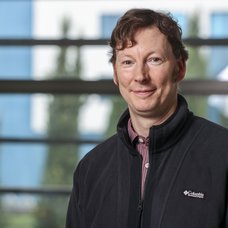
Dr. Nessan Kerrigan
Nessan Kerrigan obtained his B.Sc. in Chemistry from University College Dublin (1992-1996). He then completed his Ph.D. in Chemistry at University College Dublin (1996-2000) under the direction of Professor Declan G. Gilheany. He spent a year in industry working as a process development chemist for Merck before carrying out postdoctoral research at the University of Glasgow (2002-2004) with Professor David J. Procter. He carried out further postdoctoral research at the University of Pittsburgh (2004-2006) with Prof. Scott G. Nelson. Dr. Kerrigan began his independent research career at Oakland University in 2006. The Kerrigan group carries out research in the area of synthetic organic chemistry. Most of their work is of the basic/fundamental chemistry research kind and is focused on the development of new efficient methods for the construction of biologically interesting organic molecules. In August 2017, Dr. Kerrigan returned to Ireland to take up a position as Lecturer in the School of Chemical Sciences at Dublin City University.
Research Interests
Our group’s research is concerned with the development
of efficient enantioselective and diastereoselective synthetic methods, and
their application to the synthesis of drug molecules and natural products. We
also carry out extensive mechanistic studies of our new reactions, principally
through NMR spectroscopy (e.g. 31P NMR and 1H NMR), to
gain mechanistic insight, identify intermediates, and establish general
patterns of reactivity. Much of our
studies in recent years have involved the development of chiral organic
nucleophile-catalyzed synthetic methods.
Specifically, we have developed a number of chiral phosphine-catalyzed
reactions of ketenes providing versatile methods for the asymmetric synthesis
of biologically important molecules such as β-lactones (ketene dimers and
saturated β-lactones) and β-lactams.
In 2012, we disclosed the first catalytic asymmetric
heterodimerization of ketenes. This reaction was catalyzed by an alkaloid
nucleophile (a quinine or quinidine derivative) to give a β-lactone ketene
heterodimer product. One current avenue of intense research in our lab involves
elaboration of our ketene heterodimer products to cancer therapeutic agents and
complex molecules isolated from mycobacterium tuberculosis. We also have an interest in sulfur and
phosphorus chemistry, as well as the development of new transition metal-catalyzed
cross-coupling reactions. In the area of
sulfoxonium ylide chemistry, we published a modification of the
Johnson-Corey-Chaykovsky reaction which facilitated a synthesis of
gamma-lactones, through interception of a sulfoxonium ylide-derived betaine
intermediate by a ketene molecule. This work has more recently led to us to
investigate new reactions of vinyl sulfoxonium salts, providing routes to
pharmaceutically important cyclic molecules.